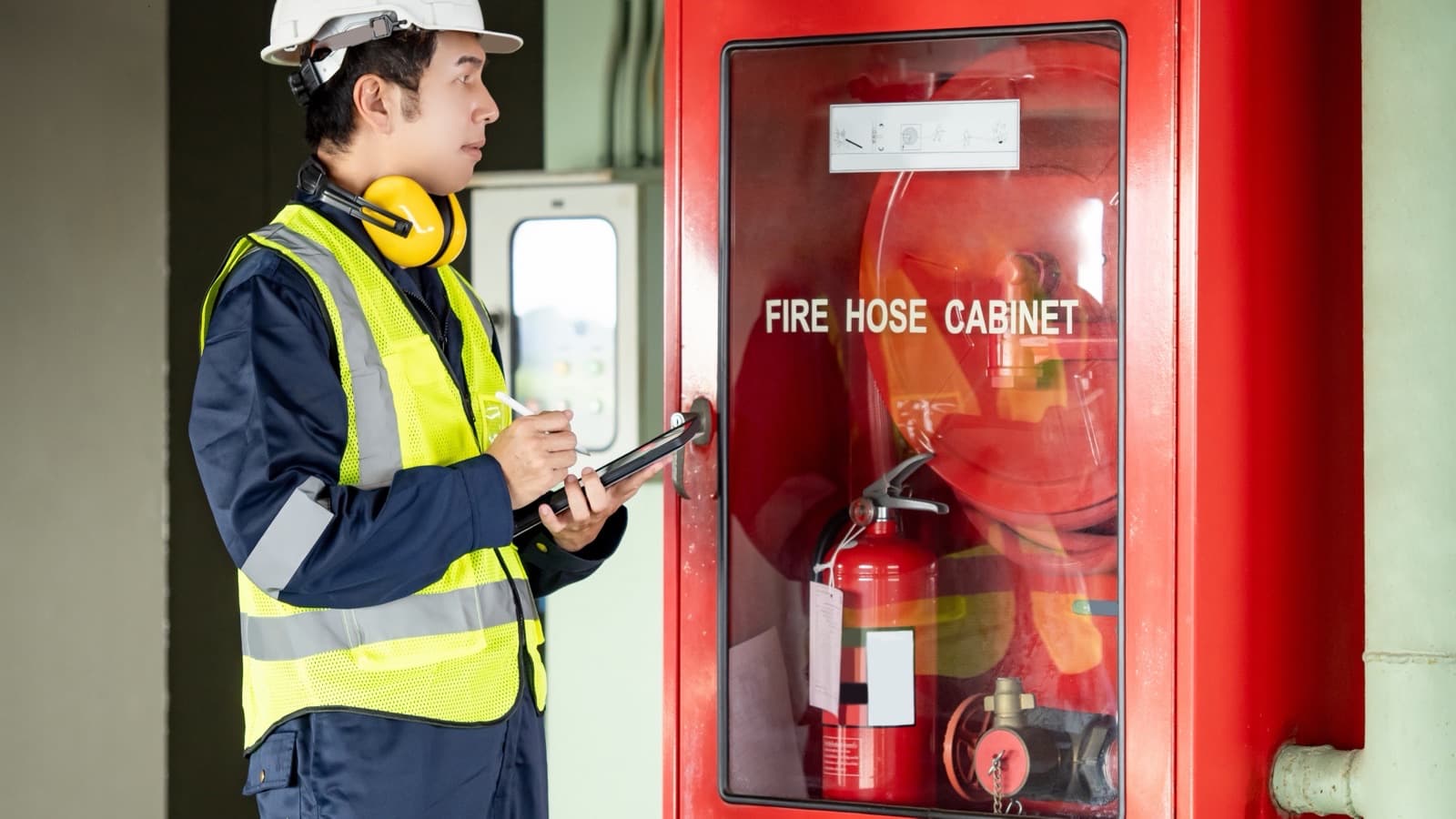
The monthly fire extinguisher check is the most repeated safety inspection in most buildings, and one of the least examined. An extinguisher hangs on a wall for years, somebody initials the tag every month, and the only time anyone finds out whether it would have worked is the day it is needed. It is also one of the few routine checks with a clear federal rule behind it, covering how often to look, how often to maintain and which records to keep. This article sets out what that rule requires, what it leaves to the employer, and how to make the monthly walk worth doing.
A note on scope: this summarizes the federal OSHA standard for general industry, 29 CFR 1910.157, which covers the placement, use, maintenance and testing of portable fire extinguishers provided for employees' use. States with their own OSHA-approved plans can set different rules, construction and maritime have their own standards, and local fire codes and insurers often add requirements, many of them by reference to NFPA 10, which is not quoted here. Nothing in this article is legal advice.
What the standard requires
The inspection, maintenance and testing duties sit in 29 CFR 1910.157(e) and (f), and the first sentence of paragraph (e) settles who owns them: the employer is responsible for the inspection, maintenance and testing of all portable fire extinguishers in the workplace. A service contractor can do the work, but the duty does not move. From there the standard sets three clocks.
- Monthly: a visual inspection. Portable extinguishers, and any hose used in place of them under paragraph (d)(3), are visually inspected monthly (1910.157(e)(2)). This is the walk-around check: the unit is where it should be, accessible and apparently in working order.
- Annually: a maintenance check. Each extinguisher is subjected to an annual maintenance check (1910.157(e)(3)). Stored-pressure extinguishers do not need an internal examination at this check. The employer records the date of the annual maintenance, keeps that record for one year after the last entry or the life of the shell, whichever is less, and makes it available to OSHA on request.
- Every 6 years: internal maintenance for most dry chemical units. Stored-pressure dry chemical extinguishers that require a 12-year hydrostatic test are emptied and subjected to applicable maintenance procedures every 6 years (1910.157(e)(4)). Non-refillable disposable units are exempt, and when a unit is recharged or hydrostatically tested, the 6-year count restarts from that date.
Hydrostatic testing has its own timetable, Table L-1 of the standard (1910.157(f)(2)). The interval is 5 years for most water-based, foam, wetting agent, loaded stream and carbon dioxide extinguishers and for dry chemical units with stainless steel shells, and 12 years for stored-pressure or cartridge-operated dry chemical units with mild steel, brazed brass or aluminum shells, for dry powder units with mild steel shells, and for Halon 1211 and 1301. Testing is done by trained persons with suitable equipment (1910.157(f)(1)), never with air or gas pressure (1910.157(f)(13)), and a unit is also retested whenever it shows new evidence of corrosion or mechanical injury (1910.157(f)(4)). A shell that has been repaired by soldering, welding, brazing or patching compounds, has damaged threads, shows pitting corrosion, has been burned in a fire, or has held a calcium chloride agent in a stainless steel shell is not tested at all; shells that fail a test or are not fit for one are removed from service and from the workplace (1910.157(f)(2) and (f)(14)).
Hydrostatic tests carry their own record requirement, and it is more detailed than the annual one. The employer keeps a certification record with the date of the test, the signature of the person who performed it and the serial number or other identifier of the extinguisher, until the unit is retested at its Table L-1 interval or taken out of service, whichever comes first (1910.157(f)(16)).
Three other paragraphs shape what an inspector should expect to find. Under 1910.157(c)(1), extinguishers are mounted, located and identified so that they are readily accessible to employees without exposing them to possible injury. Under 1910.157(c)(4), they are kept fully charged and operable and in their designated places at all times except during use. And under 1910.157(d), extinguishers are selected and distributed by the classes of fire expected and the size and degree of the hazard: a travel distance of 75 feet or less to an extinguisher for Class A fires, 50 feet or less from the hazard area for Class B fires, Class C units placed on the pattern of the A or B hazards, and 75 feet or less to a Class D extinguishing agent in combustible-metal working areas.
Finally, where extinguishers are provided for employees to use, the employer provides an educational program on the general principles of extinguisher use and the hazards of fighting a fire in its incipient stage, on initial employment and at least annually thereafter (1910.157(g)(1) and (g)(2)). Employees designated under an emergency action plan to use firefighting equipment are trained in the equipment itself, on initial assignment and at least annually (1910.157(g)(3) and (g)(4)).
What the standard leaves to you
Several things people assume are spelled out are not.
There is no checklist in the rule. Paragraph (e)(2) says "visually inspected monthly" and nothing more. What the inspector looks at, and what counts as a fail, is the employer's decision, usually informed by the manufacturer's instructions and the fire code the local authority enforces.
The monthly inspection has no record requirement in the federal text. The only records the standard names are the annual maintenance date in (e)(3) and the hydrostatic test certification in (f)(16). The familiar hanging tag with twelve boxes for initials is a convention, not a federal mandate. It is also, for most sites, the only evidence that the monthly walk happened, which is why keeping a record is sensible even where it is not required, and why fire marshals and insurers tend to ask for one.
The annual maintenance check is not defined item by item. The standard requires that it happen and that the date be recorded. What it consists of comes from the manufacturer's instructions and from the standards the local authority has adopted; many authorities and insurers reference NFPA 10. Whoever performs the check should be able to say what was done, not only when.
Who inspects is your call. The monthly check needs no particular qualification in the text. Hydrostatic testing, by contrast, is done by trained persons with suitable equipment and facilities, which in practice means a service company.
Some workplaces are partly or wholly exempt. An employer with a written policy of immediate and total evacuation on the fire alarm, an emergency action plan and a fire prevention plan, and no extinguishers available in the workplace is exempt from the section unless another standard requires an extinguisher (1910.157(b)(1)). Where only designated employees may use extinguishers and everyone else evacuates, the distribution rules in paragraph (d) do not apply (1910.157(b)(2)). And where extinguishers are provided but not intended for employee use, only the inspection, maintenance and testing paragraphs (e) and (f) apply. Note what survives every exemption: if the extinguisher is on the wall, it still gets inspected and maintained.
What a monthly check should cover
Because the standard does not list the items, a good monthly checklist starts from what the standard does require of an extinguisher at rest: in its designated place, accessible, identified, fully charged and operable. Most monthly checklists cover the following.
Location and access:
- The extinguisher is in its designated place, on its bracket or in its cabinet, and the location is marked so that it can be found.
- Nothing blocks access to it or the view of it: pallets, carts, stock, a door that now opens the other way.
- It is the right type for the hazards around it, and the travel distance still makes sense if the area has been rearranged.
Condition of the unit:
- The pressure gauge needle, where there is a gauge, sits in the operable range.
- The pull pin is in place and the tamper seal is intact.
- No dents, corrosion, leakage or clogging; the hose and nozzle are intact and not blocked.
- The operating instructions and the label are legible and face outward.
- Cartridge-operated units are checked the way the manufacturer specifies. Carbon dioxide units have no gauge, so a loss of agent shows up as a loss of weight, and many programs weigh them.
Dates and records:
- The tag or label shows the last annual maintenance date, and it is less than a year old.
- The 6-year maintenance date and the hydrostatic test date on the shell are within their intervals for that type of unit.
- The inspection is recorded against this specific extinguisher, by serial number or an asset identifier.
Our fire extinguisher monthly inspection checklist covers these items and can be downloaded free as a PDF, Excel or Word file. Treat it as a starting point to adjust against the manufacturer's manual for the units you actually have and the code your local authority enforces.
The standard does not describe what happens when the monthly check finds a problem, but two of its requirements settle the outcome. An extinguisher is kept fully charged and operable at all times except during use (1910.157(c)(4)), so a unit with a gauge in the red, a missing pin, a damaged hose or a lapsed maintenance date is not meeting the rule until it is fixed. And when an extinguisher is removed from service for maintenance or recharging, the employer provides alternate equivalent protection in the meantime (1910.157(e)(5)). A bare bracket is not an acceptable interim state.
That turns a failed item into three pieces of work: take the unit out of service in a way the next person can see, put a replacement in its place, and get the defective one to whoever maintains it. On paper, those steps tend to stall. The finding is written on the tag, the tag stays on the wall, and the extinguisher sits half-empty for a month because nobody carried the information from the wall to the person with a spare. A few decisions prevent that:
- Agree in advance what fails a unit. Gauge out of range, missing or broken seal, visible damage, a blocked location, a lapsed annual date. The inspector should not have to decide case by case.
- Make the out-of-service state visible. A tag on the unit, a note on the bracket, and a loaner hung in its place.
- Send the defect as work, not as a note. The finding should reach the person or contractor who services extinguishers as a task against that unit, with what was found and, ideally, a photo.
- Track by serial number. The hydrostatic certification record already identifies units that way (1910.157(f)(16)). Using the same identifier for monthly findings and annual dates keeps one history per extinguisher.
We look at why findings stall between the inspection and the repair in why inspection findings stall before they become work orders.
Making the check real
Monthly extinguisher inspections are easy to pencil-whip: twelve boxes on a tag, initialed in a batch from the doorway. The fixes are mostly practical.
- Inspect from a list of locations, not from memory. The most common finding on a first proper round is an extinguisher nobody knew was missing, or one that moved with a wall. A route with every unit on it, built from the floor plan, turns "did we check them all" into a count.
- Tie each inspection to the specific unit. A QR code or NFC tag on the bracket that opens that extinguisher's own checklist and history removes the question of which unit was inspected, and shows the inspector any defect still open on it.
- Require evidence for failures, not for passes. A photo and a short note when a gauge is in the red adds seconds; asking for a photo of every green gauge adds minutes and resentment.
- Let the dates drive the work. The annual maintenance date, the 6-year internal maintenance and the hydrostatic test interval all belong to the unit. When they are recorded against it, the service calls can be scheduled from the records instead of discovered on the wall.
- Keep the records the standard names where they can be found. The annual maintenance date for a year after the last entry or the life of the shell, and the hydrostatic certification until the next test or removal from service. The monthly record is not required federally, but it is what shows the check happened.
- Make coverage visible. A supervisor should be able to see, before the month ends, which units have been inspected, which have open defects and which are out of service with a loaner in place.
This is the same pattern behind any inspection that gets done rather than merely signed: the check is tied to an asset, failures become work with an owner, and the history accumulates where the next person can see it. We go into the organizational side in safety inspections that get done.
Quick summary
- The employer is responsible for inspecting, maintaining and testing every portable extinguisher in the workplace (1910.157(e)(1)).
- Visually inspect extinguishers monthly (1910.157(e)(2)). The rule does not prescribe a checklist or require a record of the monthly check.
- Give each extinguisher an annual maintenance check and record the date; keep that record for one year after the last entry or the life of the shell, whichever is less (1910.157(e)(3)).
- Empty and internally maintain stored-pressure dry chemical units on the 12-year hydrostatic schedule every 6 years (1910.157(e)(4)).
- Hydrostatically test at the Table L-1 intervals, 5 or 12 years depending on the type, by trained persons, and keep a certification record with the date, the tester's signature and the serial number (1910.157(f)).
- Keep extinguishers fully charged, operable and in their designated places, and provide alternate equivalent protection while a unit is out for maintenance or recharging (1910.157(c)(4) and (e)(5)).
- Educate employees on extinguisher use on hire and at least annually, and train designated users on the equipment on assignment and at least annually (1910.157(g)).
If you run checks like this across a building, a plant or several sites, see how Vardian handles safety inspections and corrective action: checklists on the phone, tied to each extinguisher, with failed items that become work orders.